

Poor Compressed Air Quality impacts Nitrogen Purity
- David De Pril
- Jul 17, 2025
- 2 min read


In many industrial applications, nitrogen generators—especially those based on Pressure Swing Adsorption (PSA) or Membrane technology—rely heavily on a consistent supply of clean, dry compressed air. One often overlooked but critical factor in this supply chain is the pressure dew point of the compressed air. A poor dew point, indicating high moisture content, can significantly degrade nitrogen purity and jeopardize the integrity of processes that depend on it.
Understanding Pressure Dew Point and Its Role
The pressure dew point is the temperature at which water vapor in the air begins to condense. In compressed air systems, a low enough but more importantly a stable dew point is desirable to ensure that moisture does not enter sensitive equipment like nitrogen generators.
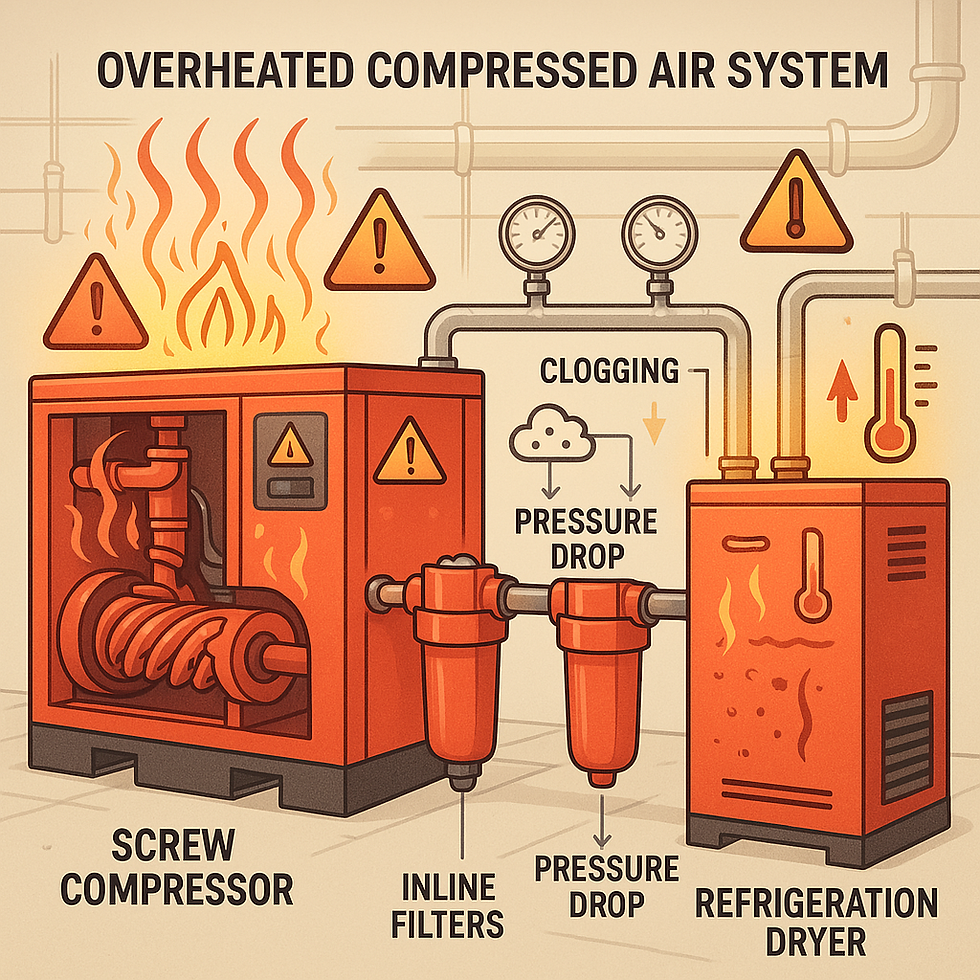
When the dew point is too high—often due to a malfunctioning or undersized fridge dryer—excess moisture enters the nitrogen generator. This can lead to:
Saturation of adsorbent materials in PSA systems (e.g., carbon molecular sieves)
Reduced membrane efficiency in membrane-based systems
Corrosion and fouling of internal components
Increased maintenance and downtime
Impact on Nitrogen Purity
Moisture in the feed air directly affects the selectivity and adsorption capacity of nitrogen generators. In PSA systems, water competes with oxygen during the adsorption process, reducing the system’s ability to separate nitrogen effectively. This results in:
Lower nitrogen purity (e.g., dropping from 99.999% to below 95%)
Fluctuating purity levels, which can be difficult to detect without continuous monitoring
Increased oxygen and moisture content in the nitrogen output
Consequences for Downstream Processes
The implications of compromised nitrogen purity vary depending on the application, but they can be severe:
1. Food and Beverage Industry
Oxidation of products due to residual oxygen
Spoilage and reduced shelf life
Regulatory non-compliance
2. Pharmaceutical Manufacturing
Contamination of sterile environments
Degradation of sensitive compounds
Batch rejection and financial loss
3. Electronics and Semiconductor Fabrication
Corrosion of components
Reduced yield and product reliability
Costly rework or scrapping of materials
4. Laser Cutting and Welding
Poor cut quality due to oxygen interference
Increased scrap and rework
Reduced throughput
Preventive Measures
To mitigate these risks, facilities should:
Monitor dew point continuously using reliable sensors
Choose compressors with low oil carry over and outlet temperatures
Maintain and service fridge dryers regularly
Use desiccant dryers when ultra-dry air is required to reach purity level
Install pre-filtration and coalescing filters to remove bulk water and oil
Install no loss drain valves to remove condensate at aftercooler, dryers, tanks filters and eventually pipework
Audit compressed air systems periodically for leaks and inefficiencies
Conclusion
The concept and maintenance of the entire system is important. Poor nitrogen purity isn't an option hence the selection of the installation components is crucial to mitigate the risk. Your productivity and profitability depends on this capital utility. Nitrogen is like process air, it has a direct contact and impact on the quality of your product, hence the end customer satisfaction. Reach out for more detailed risk mitigation and a peace of mind operation.


Comments